How single-stair design unlocks small-lot development and multigenerational living
February 25, 2026
Our entry to the National Single-Stair Design Competition imagines an adaptable model for multigenerational living in Toronto.
By Laurence Holland and Rachel Cyr
In recent years, the shortfalls of North American housing have increasingly been attributed to a fire-safety code requirement with far-reaching consequences: the need for two exit stairs. While originally conceived to address emergencies, it quietly shapes where and how we build housing, constraining both supply and quality of life.
North America’s double-egress requirements are unusually stringent. In Europe, Asia, and South America, new apartment buildings of at least six storeys and sometimes up to 20 can be constructed with a single exit stair. In Canada, most apartment buildings taller than two storeys require a second stair.
Housing developers typically respond to this requirement by designing buildings around a double-loaded corridor: a barbell-shaped hallway linking the two stairs and flanked by units on either side. But the second stair, along with the double-loaded corridor it incentivizes, hinders new housing supply by consuming floor area. Many lots are simply too small to accommodate both, reducing the pool of sites fit for “missing middle” intensification. Alternatively, developing a building of sufficient scale requires assembling several lots — a process that increases acquisition costs and downstream housing prices.
Equally important, the double-loaded corridor has profound implications for quality of life. It typically yields long, linear units with windows on one side, limiting natural light, cross-ventilation, and opportunities for multi-bedroom layouts. As a result, these small, single-exposure apartments are seen by many Torontonians as temporary stopgaps rather than long-term homes where life can evolve.
Rooms to Grow
Led by partner Bruno Weber, KPMB recently imagined a new housing model configured around a single stair, known as a “point-access block”. Rooms to Grow — our entry to the 2025 National Single-Stair Architectural Design Competition — was designed not only to increase supply by unlocking small-lot development in Toronto, but to reconsider foundational assumptions of North American housing and establish a model for multigenerational, community-oriented living.
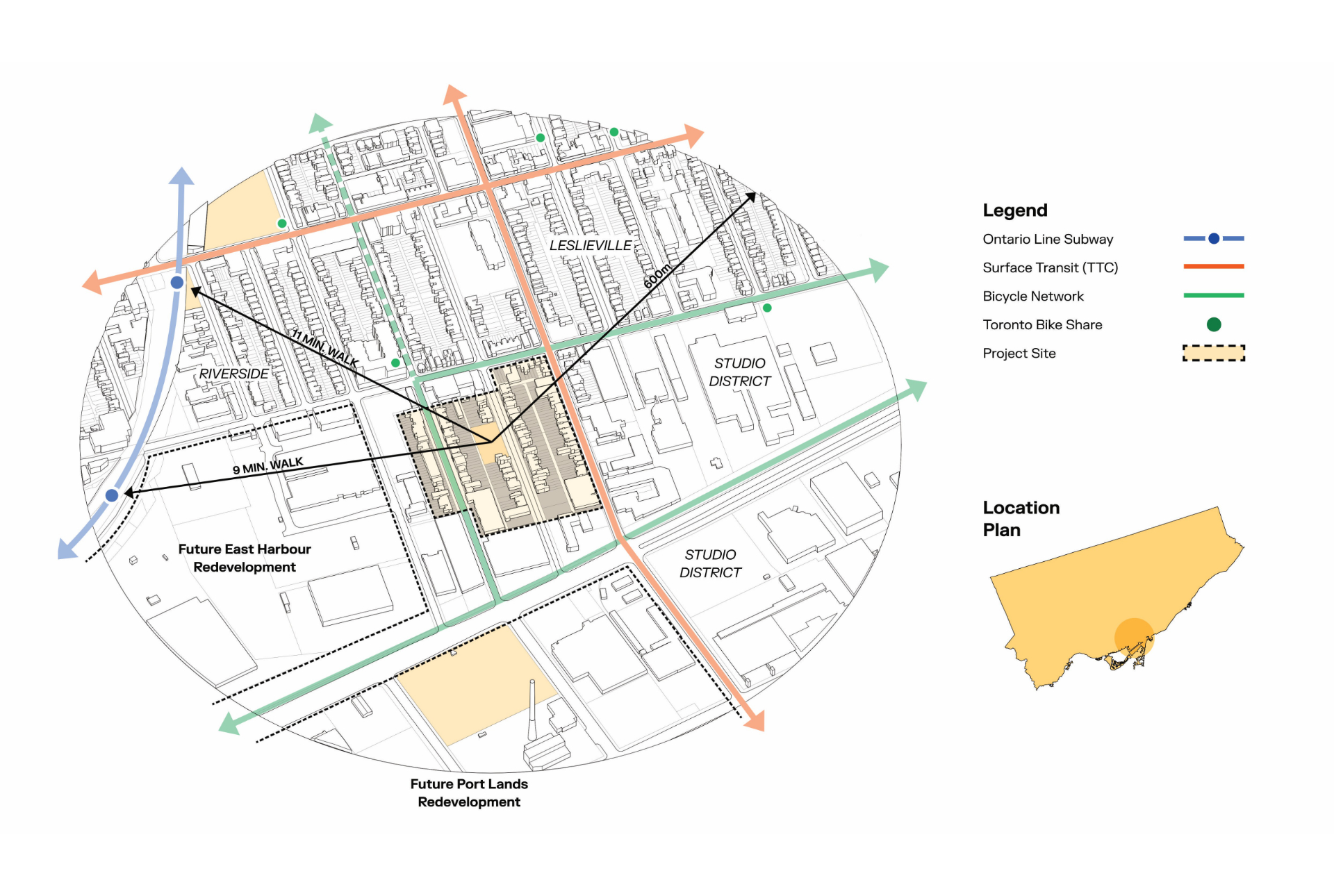
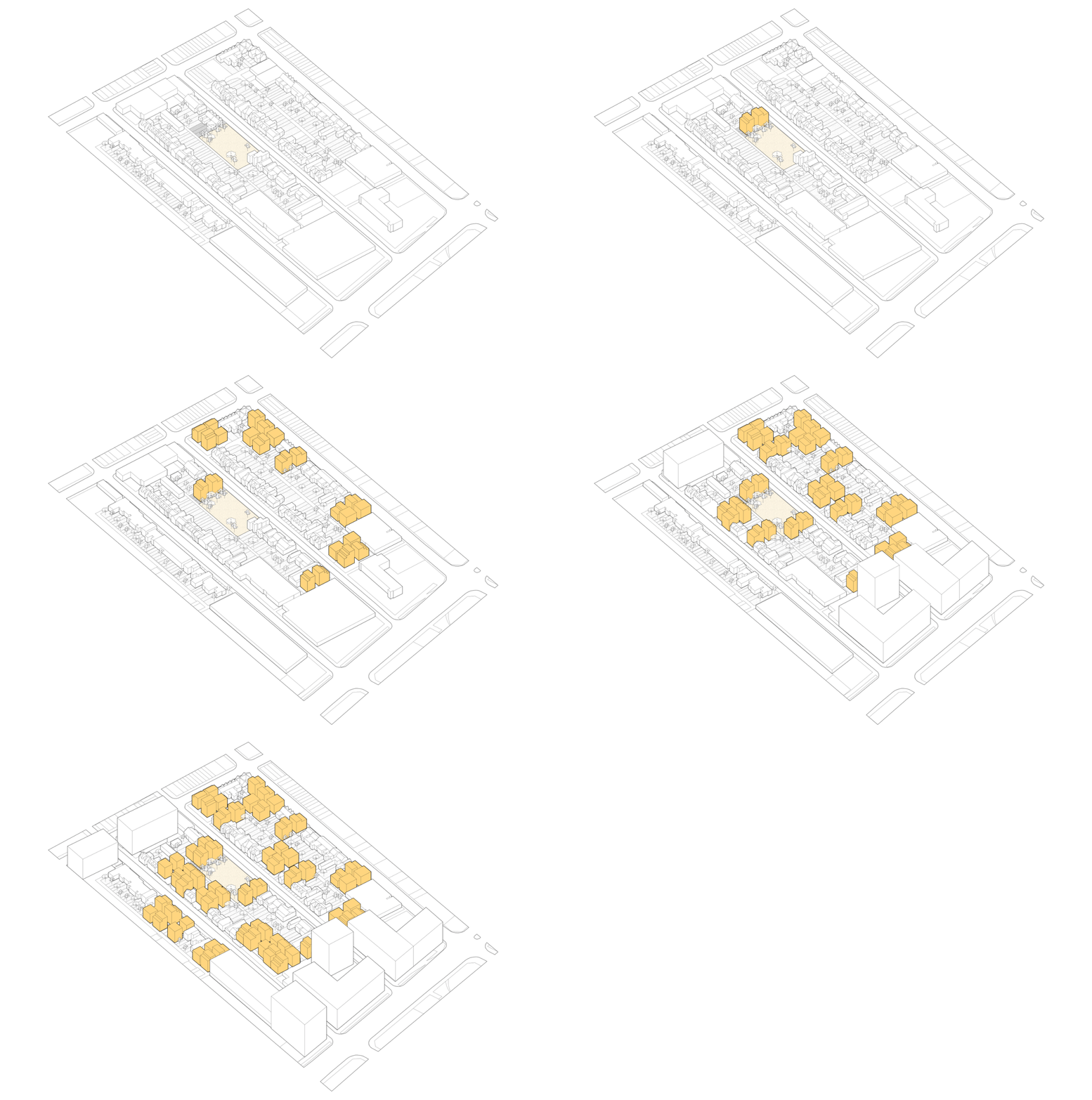
To begin, we selected a site at the southern edge of Toronto’s Leslieville neighbourhood — an isolated pocket of low-rise residential homes surrounded by light industrial uses, with a well-loved park at its heart. A new subway line and two mixed-use districts are under construction nearby. It’s an area of transitional urban scales, making it an apt test bed for a new housing paradigm. In our vision, a new housing typology takes root incrementally, fuelled by small groups of citizen developers. (Not coincidentally, we both live within a few blocks of the site.)
The building
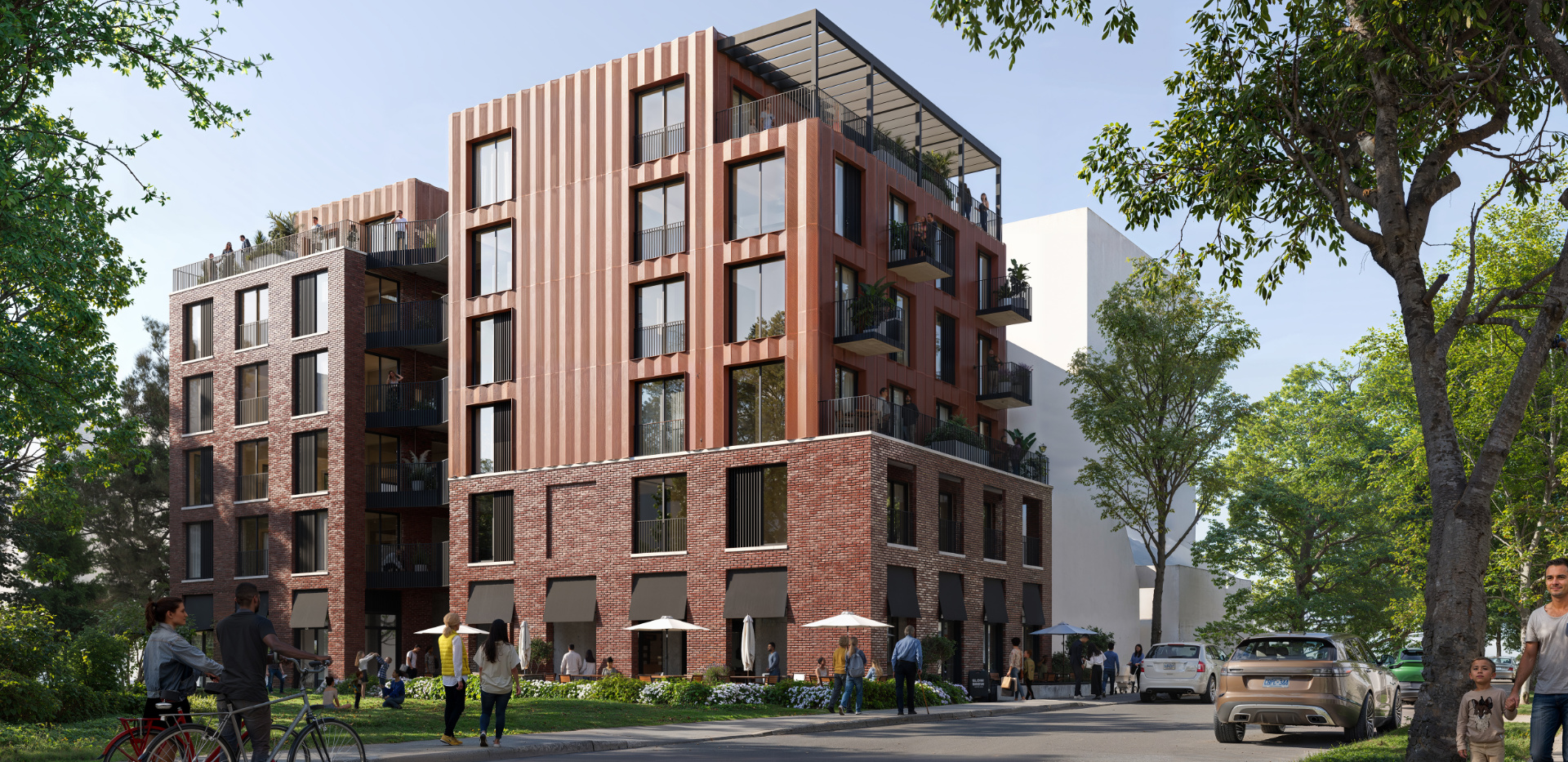
In our competition entry, we imagined that three neighbouring families assembled their parcels and partnered with an architect to build a six-storey, 20-unit building. Each family will occupy its own unit; the rest will be sold or rented to finance the development.
According to the competition rules, buildings could not exceed six storeys in height or cover more than 75 percent of their lots. Entries were permitted to ignore local zoning rules, such as setback, transitional height, or angular plane requirements. (The impact of these regulations on housing development was addressed in a recent KPMB article about the Downsview Framework Plan in northern Toronto.)
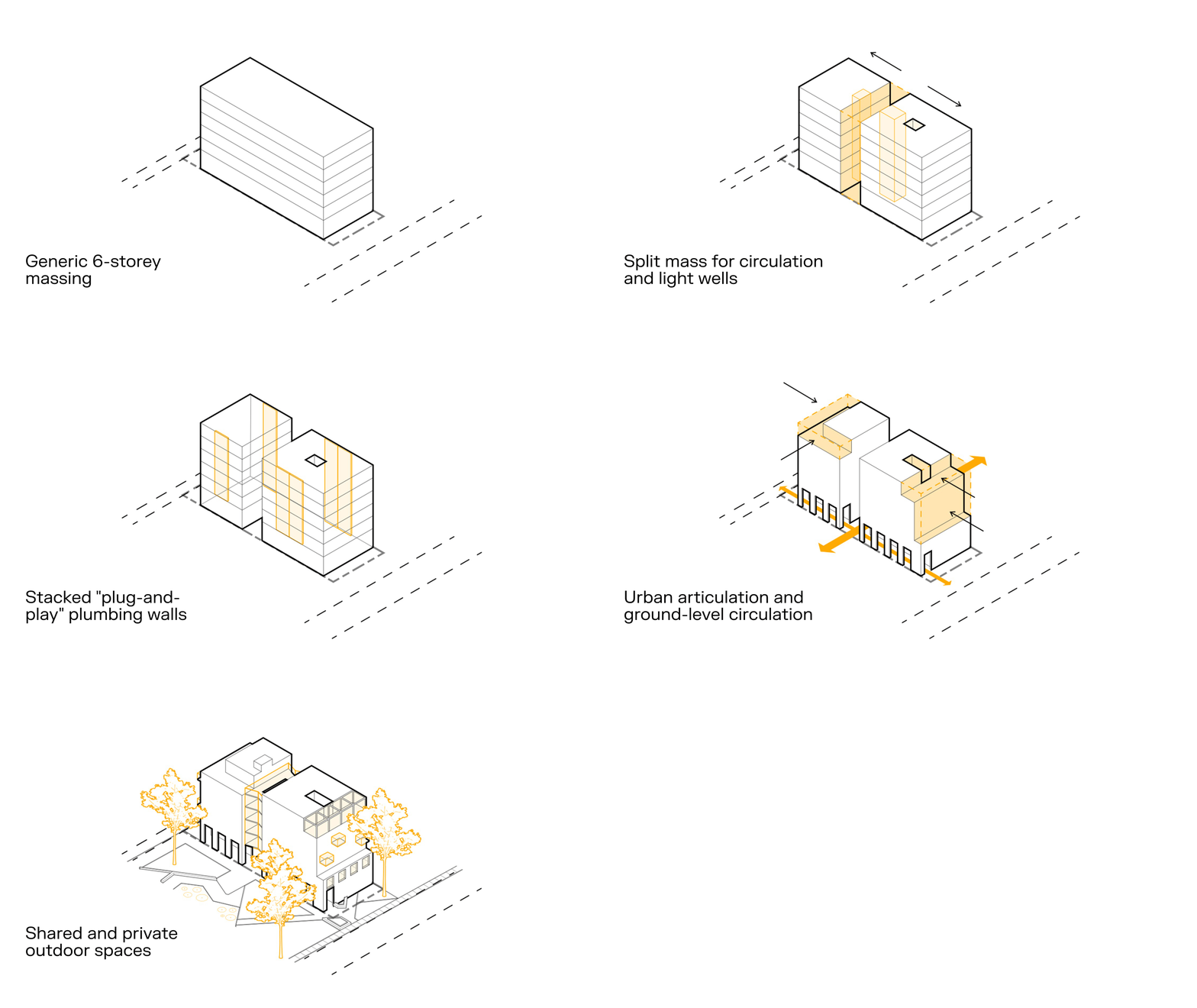
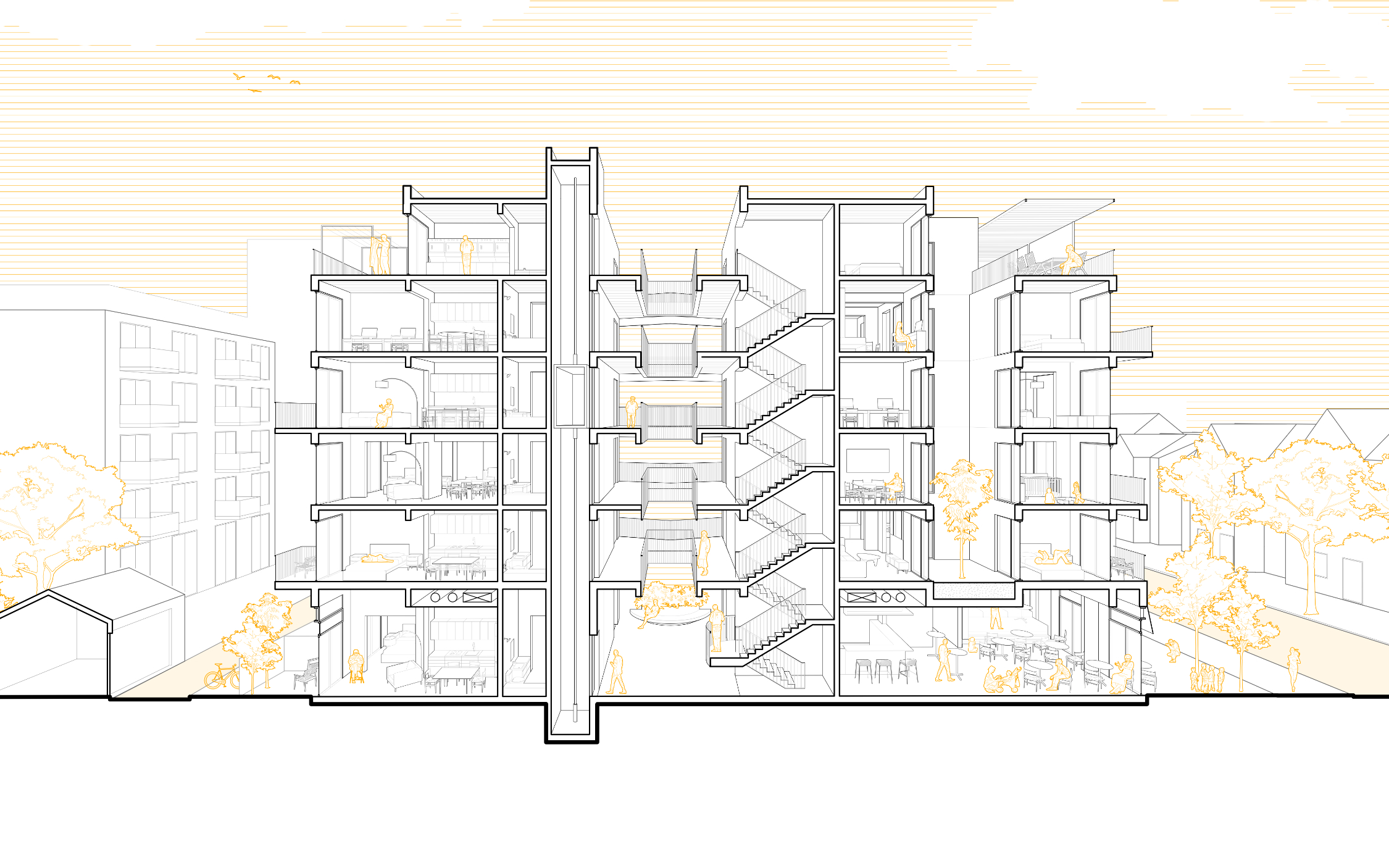
The design began with a simple six-storey mass, split at the centre to accommodate stair and elevator cores along with lightwells. The form is compact, only lightly articulated with street-facing setbacks at the third and sixth levels. A two-storey red-brick base nods to the historic residential fabric of the area, while perforated metal clads the four levels above.
Flexible design for families
New multi-unit residential development in Toronto is rarely suited for families. Typical unit orientations and a lack of exposures complicate designing layouts with multiple bedrooms. Further, the economics of land assembly often leads developers to maximize the number of units per floor. The result is a market that has skewed heavily toward studio or one-bedroom units, with families left to compete for increasingly unaffordable single-family homes.
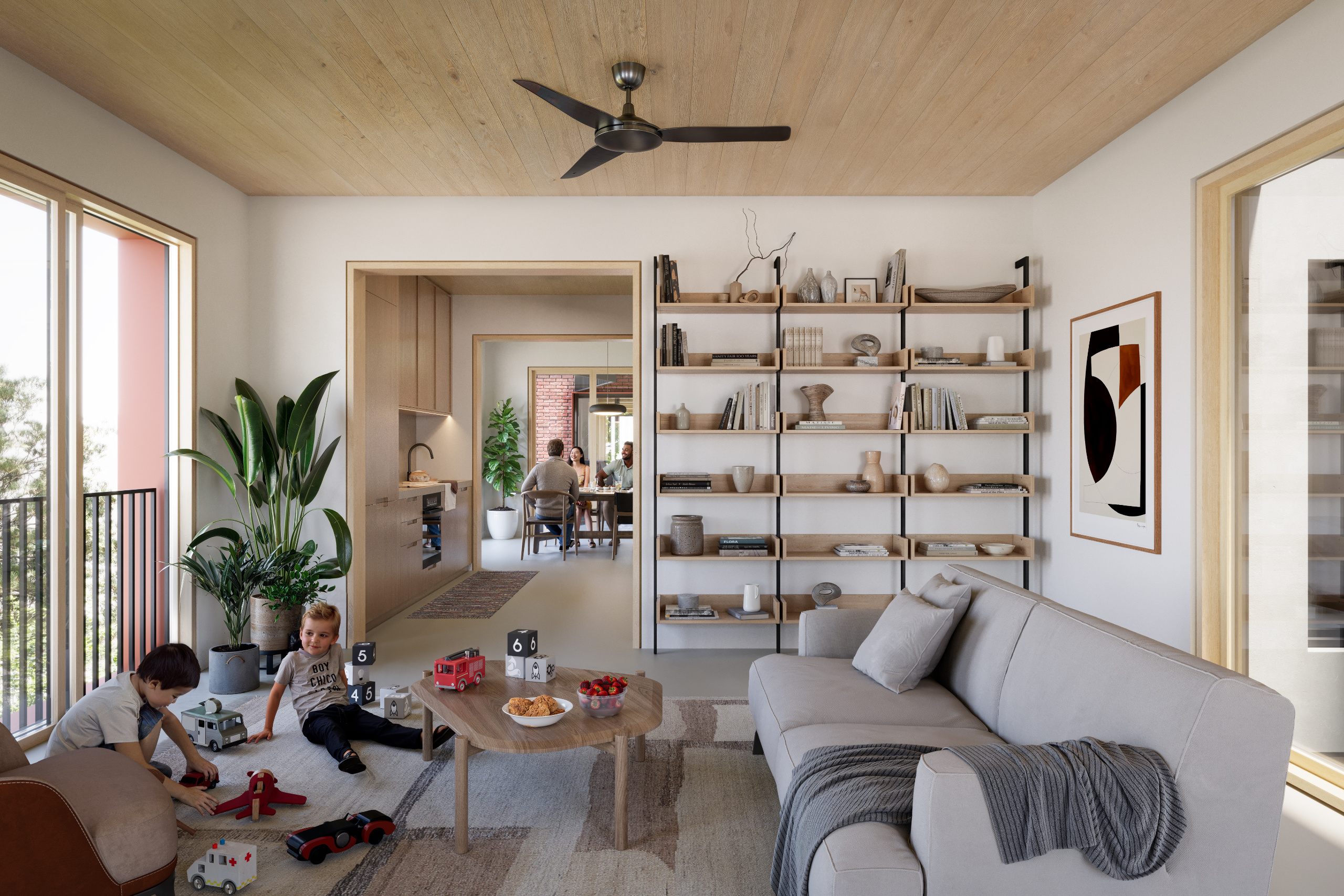
Like much European housing, Rooms to Grow leverages the virtues of a point-access block to comfortably accommodate the needs of families, especially as they grow and evolve over time. Exterior circulation and lightwells, located at mid-block, allow for double and even triple exposures, bringing natural light and fresh air deep into the floorplate, and enabling a variety of unit configurations that would be exceedingly difficult to achieve with a double-loaded corridor. Each unit opens onto a front porch, providing space for strollers and other gear while serving as a shared landing where neighbours interact.
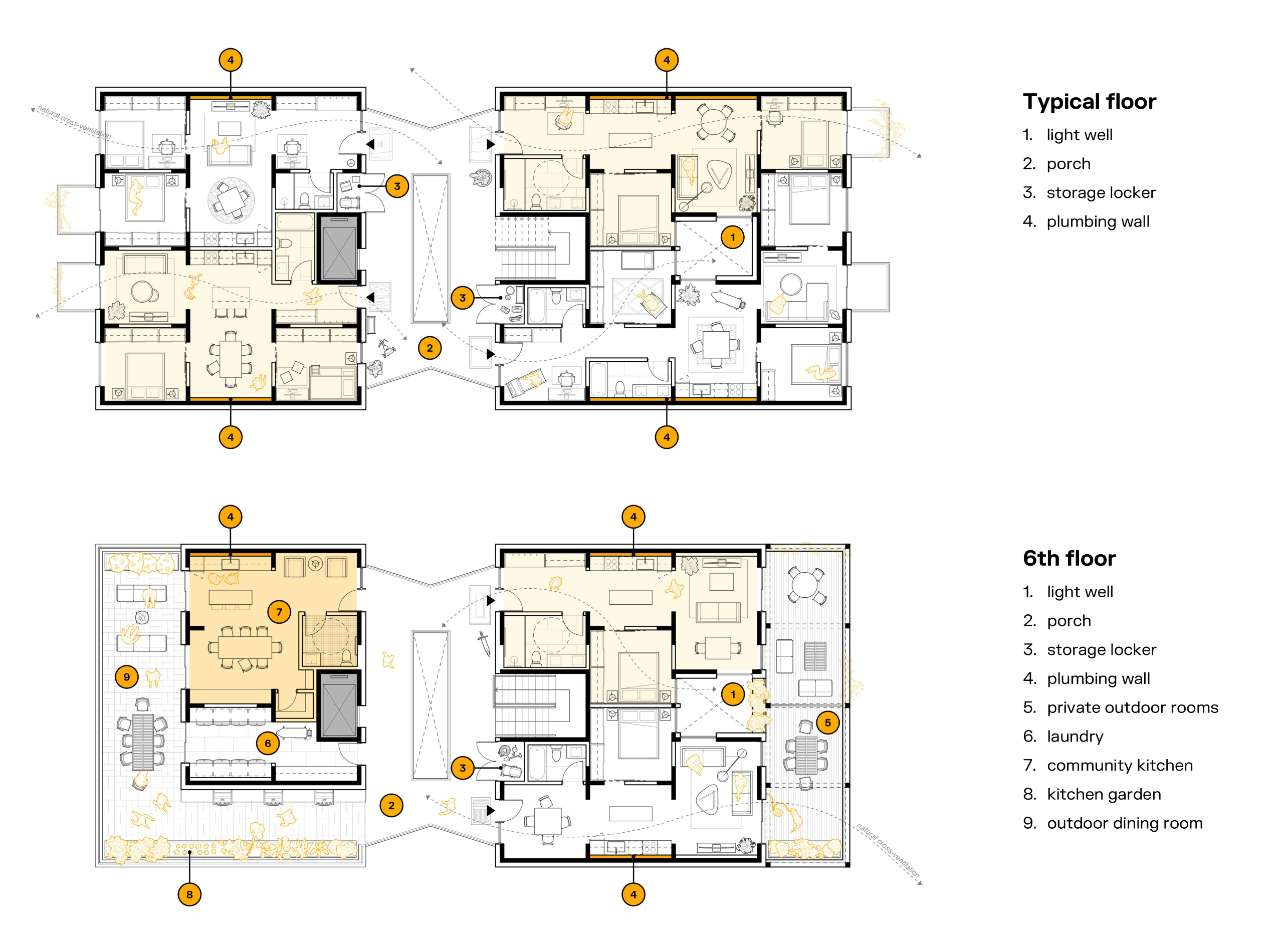
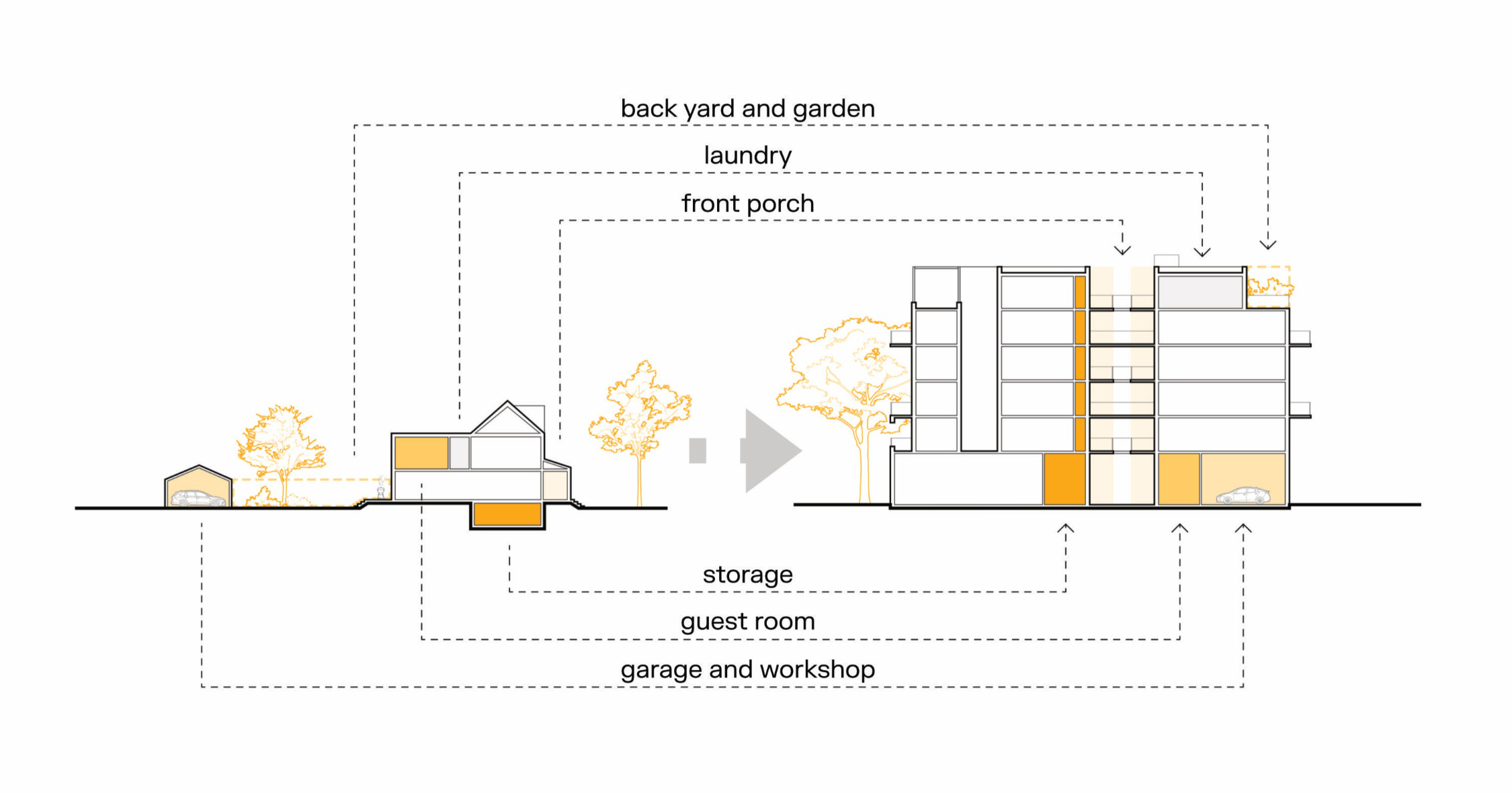
The building’s unit density is achieved partly by shifting certain amenities from the individual to the collective, recreating the affordances of single-family living in a multi-unit context.
The rooftop pavilion includes a shared laundry, garden, and communal kitchen and dining area, while the ground level accommodates a workshop, garage, café, carshare, and storage. A studio unit is reserved as a bookable guest suite, replacing the need for guestrooms within units.
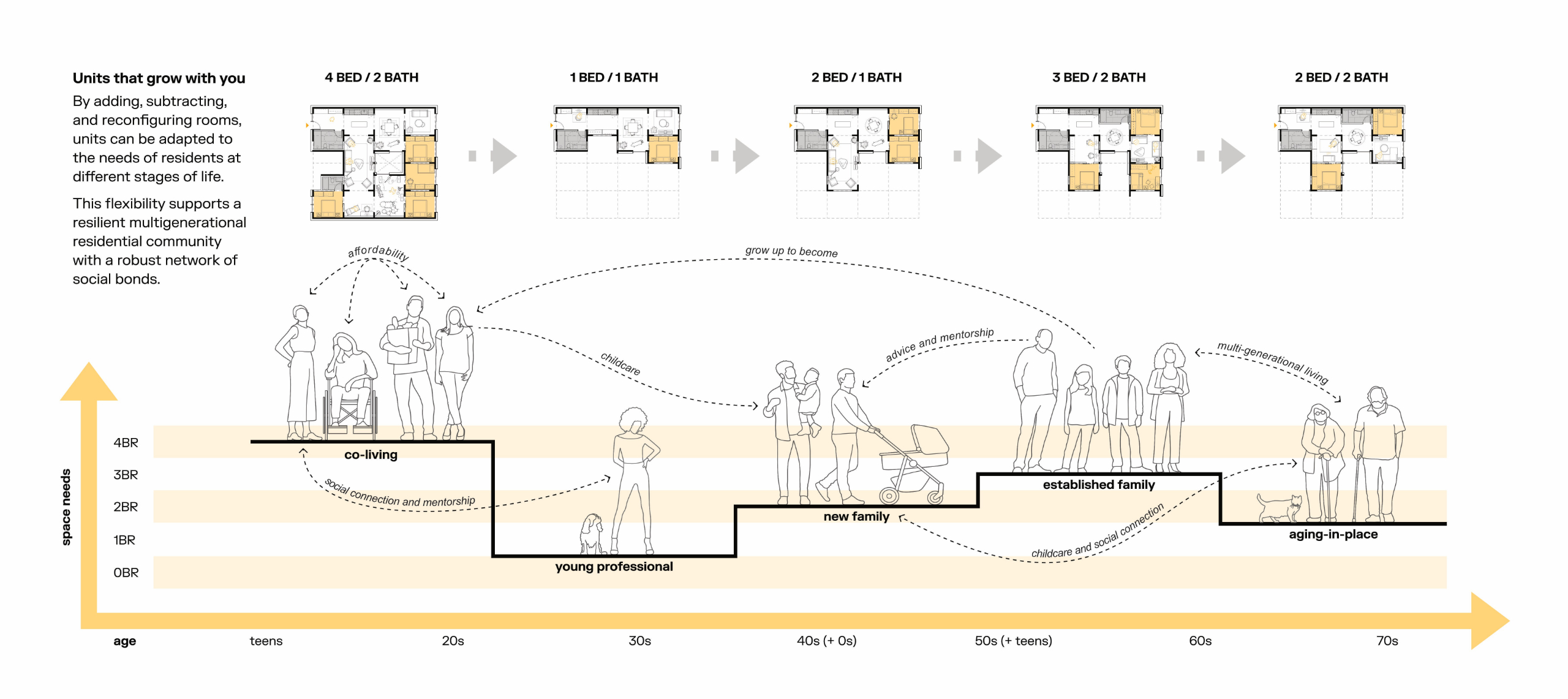
Rooms to Grow reconsiders the North American presumption that young people must outgrow their apartments or that downsizing requires older adults to move. To support the formation of a multigenerational community with strong social bonds, individual units are organized as a flexible enfilade of 140-square-foot room modules defined by solid cross-laminated timber walls.
Without the organizational complications posed by circulation corridors, the building’s planning system enables residents to buy, sell, or reimagine individual room modules, allowing for dozens of unit configurations. An older couple could sell a single room module to a growing family next door. The result is a community that is not organized around one’s stage of life but is multigenerational and symbiotic — young and old trading space as needed.
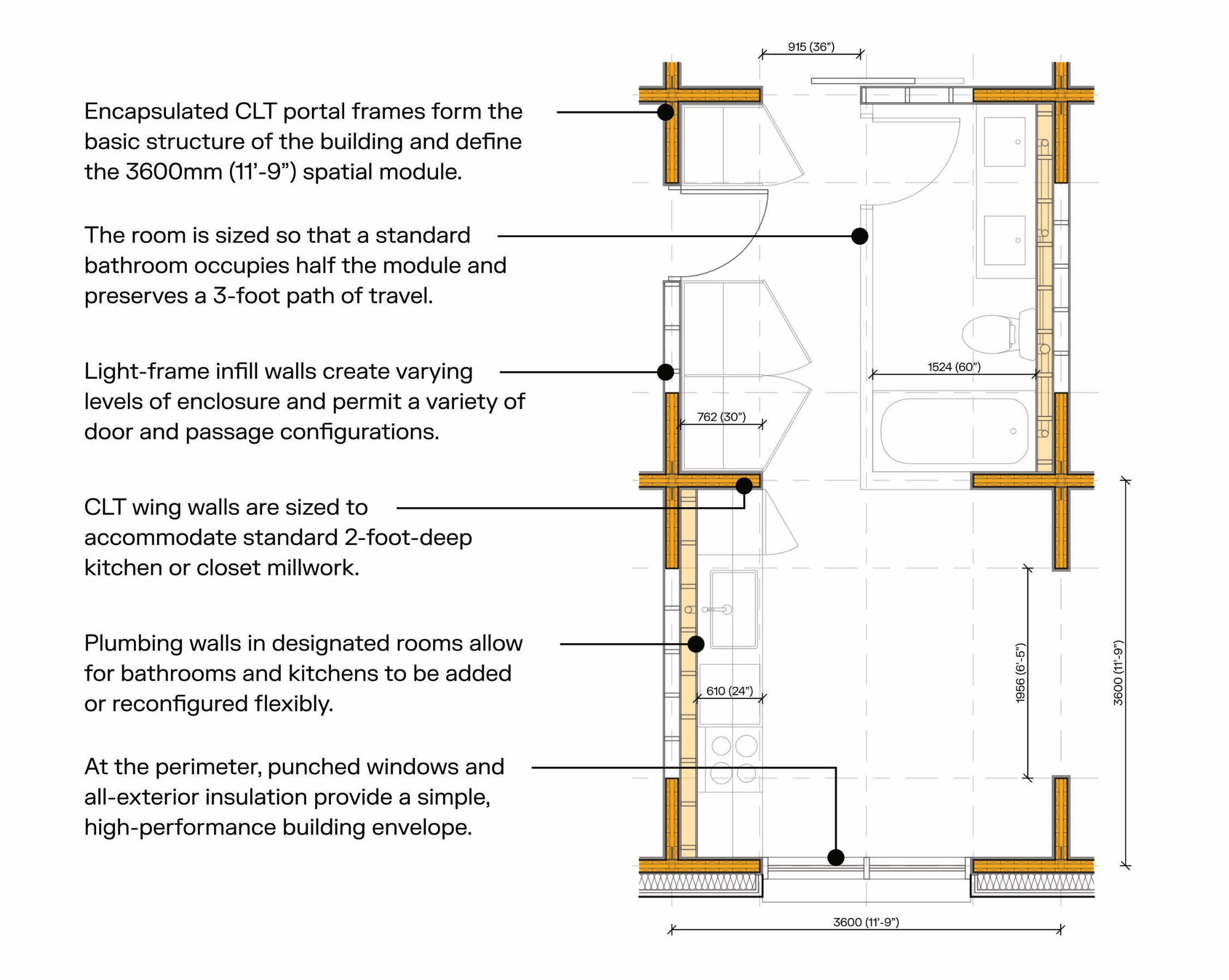
The anatomy of a room
Adaptability is critical to the success of this model. Individual room modules cannot be overly prescribed and must remain flexible. While one owner might prefer to use a module as a dining room, their neighbours may one day prefer it be a bedroom.
To maximize adaptability, the dimensions of the building’s structural grid — constructed of encapsulated cross-laminated timber (CLT) portal frames — were carefully designed. On each level, a standard module is sized for a bathroom to occupy half its floor space, while preserving a three-foot path of travel. CLT wing walls accommodate standard two-foot-deep kitchens or closets. Light-frame partition walls, along with locating plug-and-play stacked plumbing on designated exterior walls, permit a variety of possible passageways between rooms.
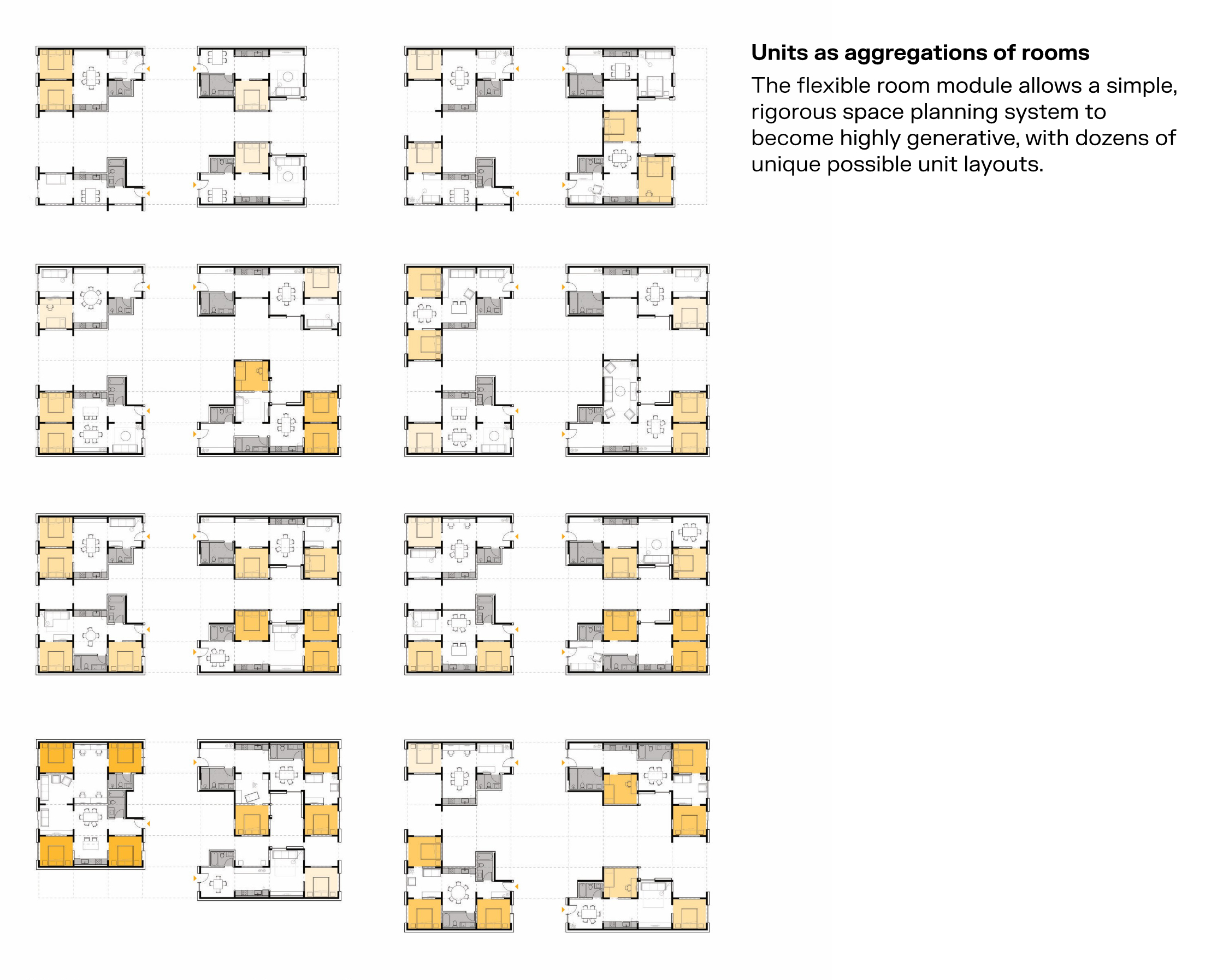
Going forward
Macro-level issues like housing supply and the individualized experience of quality of life are deeply connected. The challenge facing Toronto and many North American cities is not only to build more homes, but to create housing that is livable and can flexibly accommodate a broader range of household types and demographic groups than our current models allow.
Allowing single-stair construction is an important part of this equation. Many countries have already demonstrated that single-egress buildings are feasible at heights far beyond what is typically allowed in North America. And slowly but surely, this change is coming to Canada.
Fully embracing the single-stair model would improve life in Toronto and beyond by enabling the design of buildings with abundant natural light, cross-ventilation, and more generous layouts, and by also supporting the formation of stronger, intergenerational social bonds. Rooms to Grow imagines a shift in North American living itself, away from the atomized and towards a more connected, community-oriented model.
Laurence Holland is an associate at KPMB. Rooms to Grow draws on his proficiency in multi-unit residential design, urban design, and policy analysis. His project experience at KPMB includes Tyndale Green, Odenak, and the Downsview Framework Plan.
Rachel Cyr is a senior associate at KPMB. She has contributed to the design of workplaces, mixed-use developments, and community institutions, such as the Fort York Branch Library and the TIFF Lightbox in Toronto.
Rooms to Grow was designed by Bruno Weber, Rachel Cyr, Tae Wook Eum, Laurence Holland, Melissa Chin, and Joseph Choy.