Beyond templates: designing workplaces that endure
May 7, 2026
As the commercial office market rebounds, it’s time that workplaces embrace their individuality.
By Steven Casey and Rachel Cyr
Anyone who designs workplaces is inevitably asked: “What will employees want in the future?” It’s an important question. Like all design, a workplace must aspire for longevity. But as the past decade has repeatedly proven, the future is unpredictable. First, the pandemic reshaped work in ways no designer or strategist anticipated. Then came the predictions that commercial towers would soon become residences. And yet Toronto’s subways continue to grow more crowded as businesses return to full-time in-office work and the commercial market rebounds.
It’s exceptionally difficult to predict the future — but as workplace strategy has proliferated as a service, so too have generalized proclamations about what employees want now and in the future. Businesses often treat “future-proofing” as a shortcut to a durable and desirable workplace, sometimes even in place of dedicated engagement with leadership and staff.
This “shopping list” approach offers a striking parallel for the state of workplace design. As employers have looked to encourage staff back to the office, they have pulled from a narrow playbook: the same amenities and similar spatial responses to questions related to flexibility, autonomy, and altered sensory expectations, such as a heightened sensitivity to noise, after years of working at home. While these moves are often well-intentioned — they aim to better fit work into people’s lives — are they relevant? Are the design choices truly connected to individual and organizational needs?
In 2026, employee attraction and retention remain paramount. Relying on high-level demographic trends, however, is unlikely to produce a successful workplace on its own. When businesses chase their peers and rehash templated solutions, they risk creating problems by assuming that such choices are applicable to their own organizations.

In the wake of the pandemic, it’s become widely accepted that workers desire more autonomy regarding where and how they work in the office. The general response has been to create lounges and casual workspaces that offer a reprieve from a desk — often without fully assessing if such spaces align with an organization’s culture.
However outdated a practice it may be, many businesses continue to draw conclusions about employee performance and commitment by assessing hours spent at a desk. In such scenarios, employees understandably stay put, and it’s only a matter of time until these newly minted lounges are renovated due to underuse. (While workplace design certainly can help catalyze larger organizational transformations, doing so must be accompanied with change management for success.)
Purposeful engagement instead allows trends to be evaluated honestly against the realities of a workplace. For cultures that continue to prioritize time at a desk, the question becomes: how can autonomy be nurtured in ways that are compatible with their established norms? Finding a solution that is compatible with an organization’s culture is both a better use of resources and a more engaging design challenge.
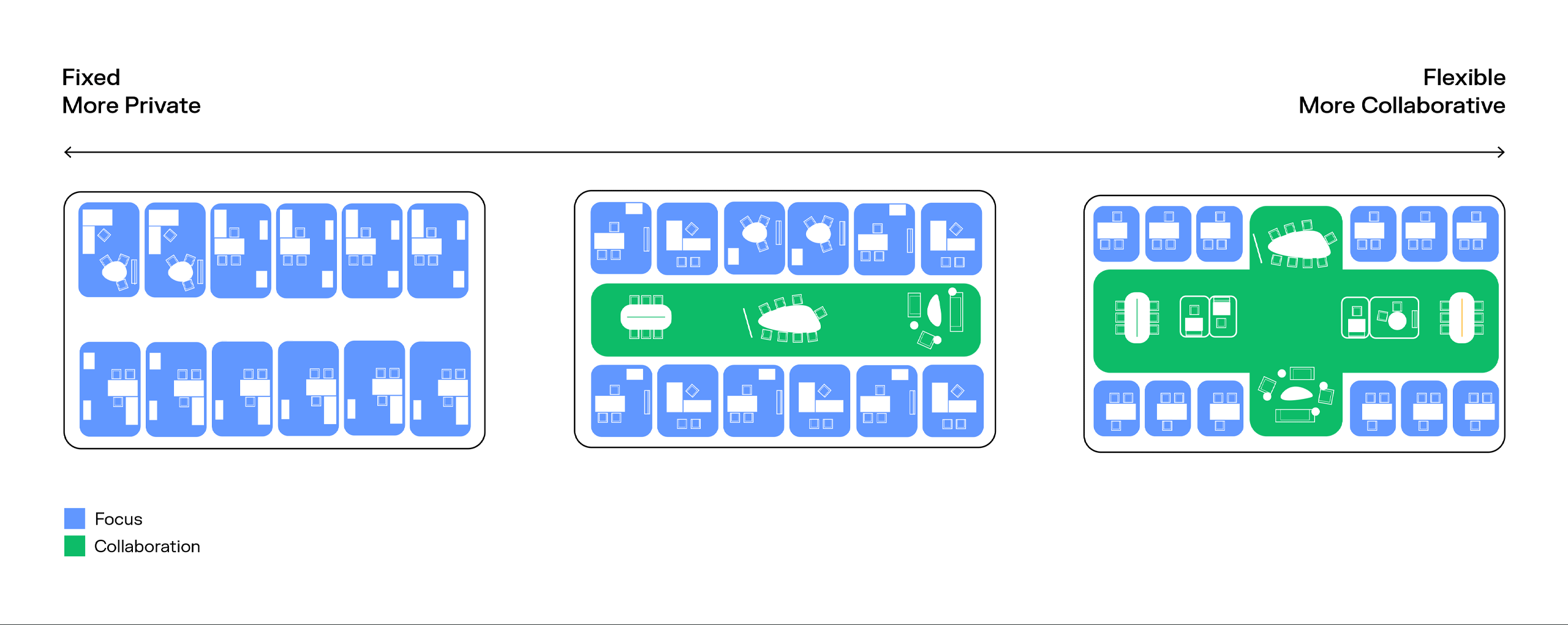
→ Visioning sessions allow users to evaluate different workplace scenarios, like the share of private versus collaborative spaces.
The typical approach to amenities exemplifies the lack of specificity that undermines many workplaces. Even before the pandemic, companies often tried to outdo one another by investing space and resources into amenities, even those disconnected from employees’ practical needs. This muscle was flexed again as employers looked to encourage staff back to the office. But even the most generous perks struggle to compete with the time people reclaim by eliminating the commute.
In the years ahead, employers should consider dedicating space and resources to amenities that help offset the impacts of commuting — whether that means rooms for mid-day telehealth appointments, onsite childcare, or simply a package collection point. But there is no one-size-fits-all solution. The needs of a new parent inevitably differ from those of early career staff or employees with decades of experience. And while workplaces increasingly emphasize considerations like “health and wellness,” those concepts are defined differently across demographics.
Another post-pandemic priority is addressing the weakened interpersonal relationships that can result from remote work. Forging strong bonds among staff is exceptionally valuable: McKinsey reported in 2024 that teams with above average trust are 3.3 times more efficient and 5.1 times more likely to produce results. Yet something as intangible as trust can be built in myriad ways — and it’s too precious and nuanced to be left to a templated formula.
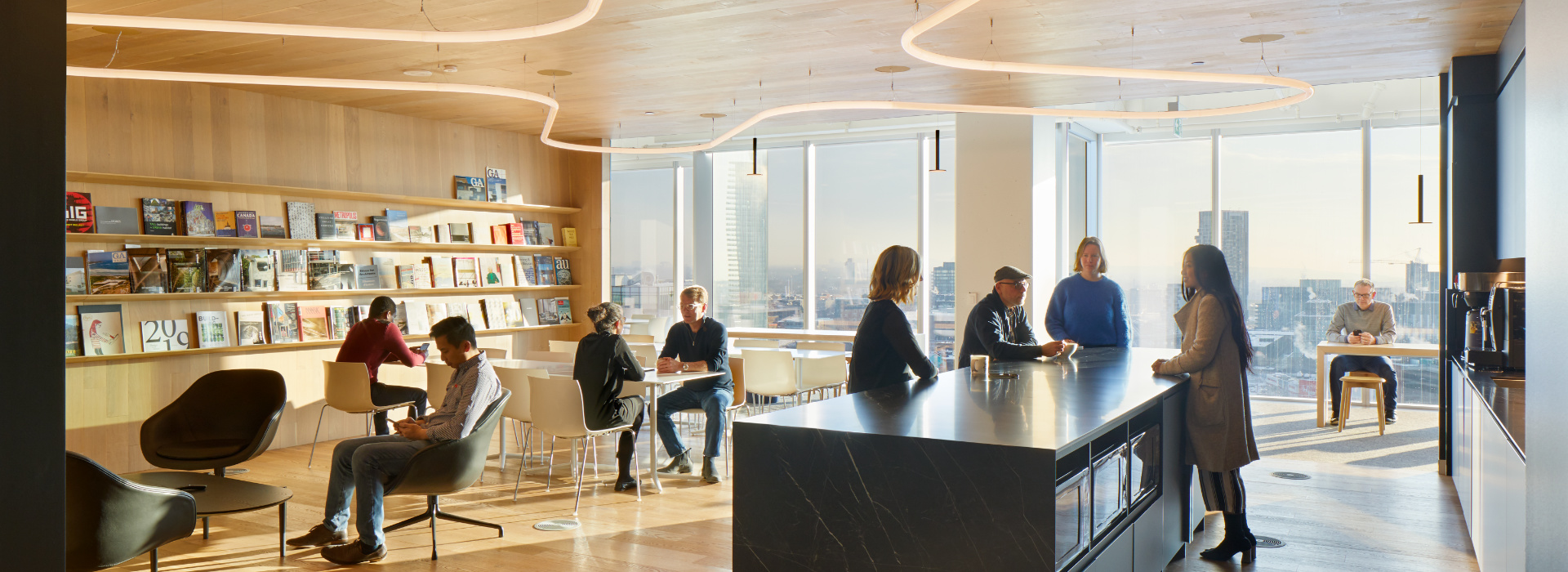
A shared kitchen and library is a place of convergence and impromptu socializing for KPMB staff in Toronto.
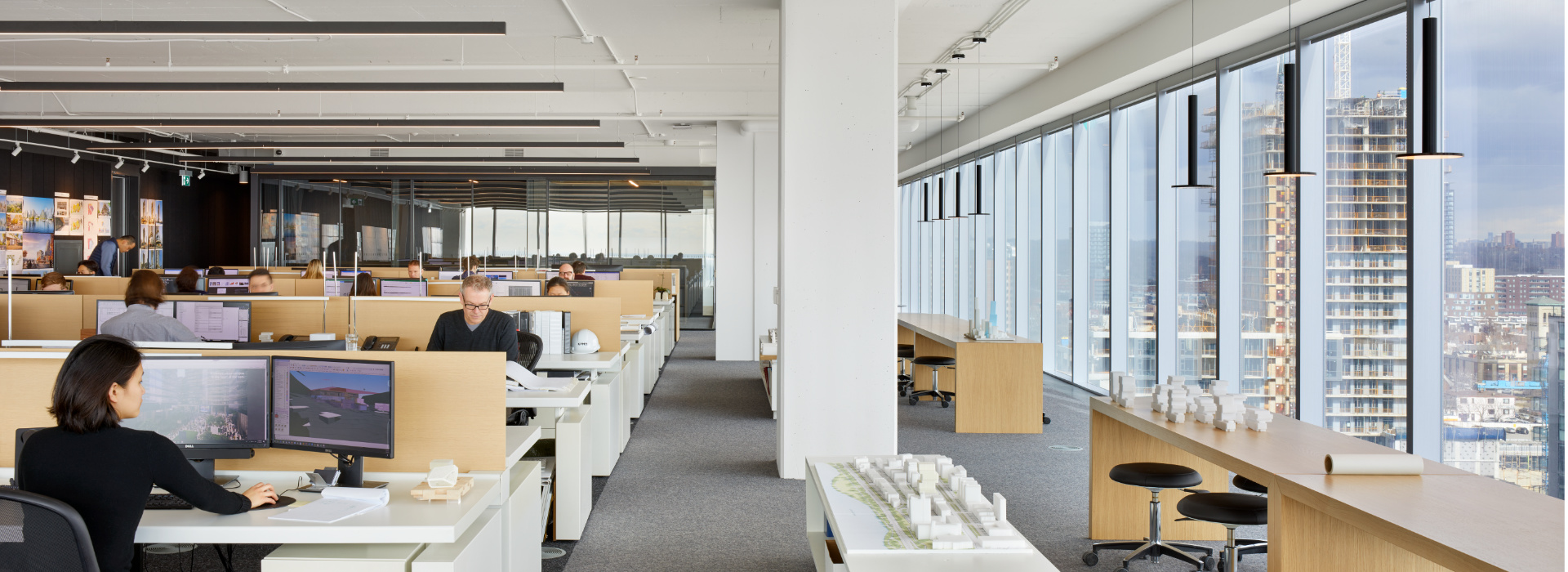
Architecture's computing demands necessitate a desk-based culture at KPMB, but fine-grained design choices, like rollable stools accompanying desks, invite colleagues to sit down and collaborate.
Increasingly, designers need to help their clients scrutinize broad-stroke solutions for current and future problems. Deciding which amenities to locate at work or how to build trust are questions without predetermined answers and best addressed through substantive engagement to achieve relevance and use resources efficiently. Although engagement requires upfront investment, ensuring that designers truly understand the nuances of an organization’s culture, identity, and values will limit false starts and pivots, while still accommodating future growth scenarios and preserving the flexibility to respond to changing market conditions.
Resisting templated solutions also creates more room for an all-too-overlooked component of the workplace: part of why people spend time in a place is because it feels good. So far, the sector’s efforts to encourage staff back to the office have been largely articulated via the services and spaces it can provide, as though design’s more experiential qualities are extraneous. But as Chodikoff summarizes: “Our unique contribution [as architects] isn’t just knowing which product or structural system to specify; it’s the ability to connect material choices to human outcomes.”
As the next generation of workplaces takes shape, they should aspire for a long life through original and genuinely relevant design. Resorting to homogenized experiences diminishes their potential to express organizational identity, support recruitment and branding, and serve as a direction-setting force that helps guide companies into an uncertain future.
Steven Casey and Rachel Cyr have collaborated on some of KPMB’s most notable workplace projects, including Scotiabank’s global headquarters in Toronto and the Hudson Yards offices of a major real estate company in New York. Since joining KPMB in 2002, Steven has also led the design of executive offices for CTV and four nationwide offices for Torys LLP. Rachel’s portfolio includes the offices of Gluskin Sheff & Associates.
(Images of KPMB: Tom Arban)